
Reformer Pilates vs Mat Pilates: Which One Is Right For You?
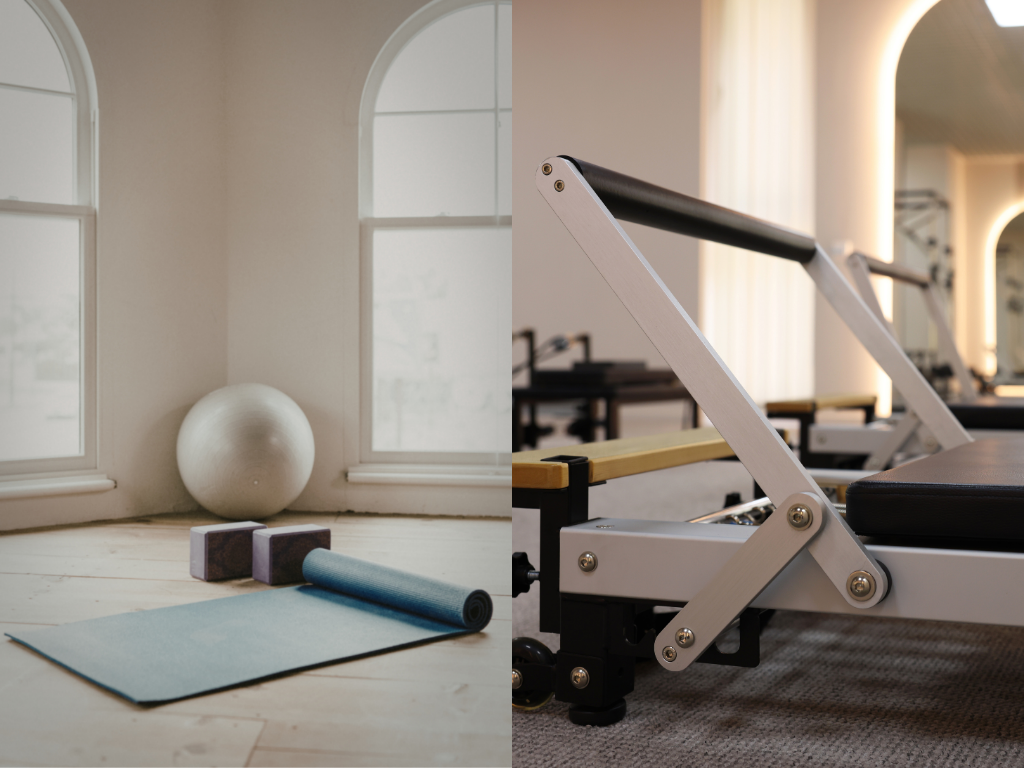
Whether you've never set foot in a Pilates studio, or you've been coming to class every week for years and are curious about what's on the other side, this one's for you. Both mat and reformer Pilates are rooted in the same beautiful method. The same principles, the same intention, the same goal: a body that feels strong, mobile, and genuinely good to live in. The difference is simply in how you get there.
Let's Start From the Beginning
Pilates was created in the 1920s by Joseph Pilates, a man who was, genuinely, decades ahead of his time. He developed the method to help people move with intention, breathe fully, and feel at home in their bodies. He created the mat exercises first. Then he invented the reformer machine to add an entirely new dimension: spring resistance, support, and the ability to work the body in ways the mat simply can't replicate.
Here's what we want you to hold onto as you read this: mat and reformer Pilates are not in competition. They're two expressions of exactly the same language. One isn't "proper" Pilates and one isn't a shortcut. They each have their genius, their community of devotees and honestly, their own kind of magic.
What Actually Happens in Each Class?
On the Mat
Mat classes are built around bodyweight movement. Think: the Hundred, Roll-Up, Single Leg Circles, Teaser. You and the floor, working with gravity — no machine, no springs, no assistance. When you nail a mat exercise with clean form and full control, there's a real satisfaction to it. You earned that, entirely on your own terms.
What mat Pilates builds above everything else is internal body awareness. Nothing is compensating for you. You have to find your core, stack your spine, and control your breath from the inside out. That awareness — of how your body is organised and how it moves — is genuinely life-changing. It's the kind of thing that makes you stand differently, sit differently, and move through your Sydney life with a quieter confidence.
On the Reformer
Reformer classes take that same Pilates vocabulary and add a whole new layer: adjustable spring resistance. The carriage slides, springs can be added or dialled back, and the straps let you work your limbs in ways that simply aren't possible on a mat. You can lie, sit, kneel, stand — positions shift constantly across a class, keeping both the body and the mind engaged.
One of the most underrated things about the reformer is that it can make exercises easier as well as harder. Springs can support a movement when you need assistance — which is why reformer Pilates is exceptional for anyone returning from injury, those in the pre- or postnatal period, or anyone who wants to build strength gradually without compromising form. The machine meets you exactly where you are.
"The mat teaches you to find it yourself. The reformer gives you the feedback to go deeper. Both change the way you live in your body – just in different ways."
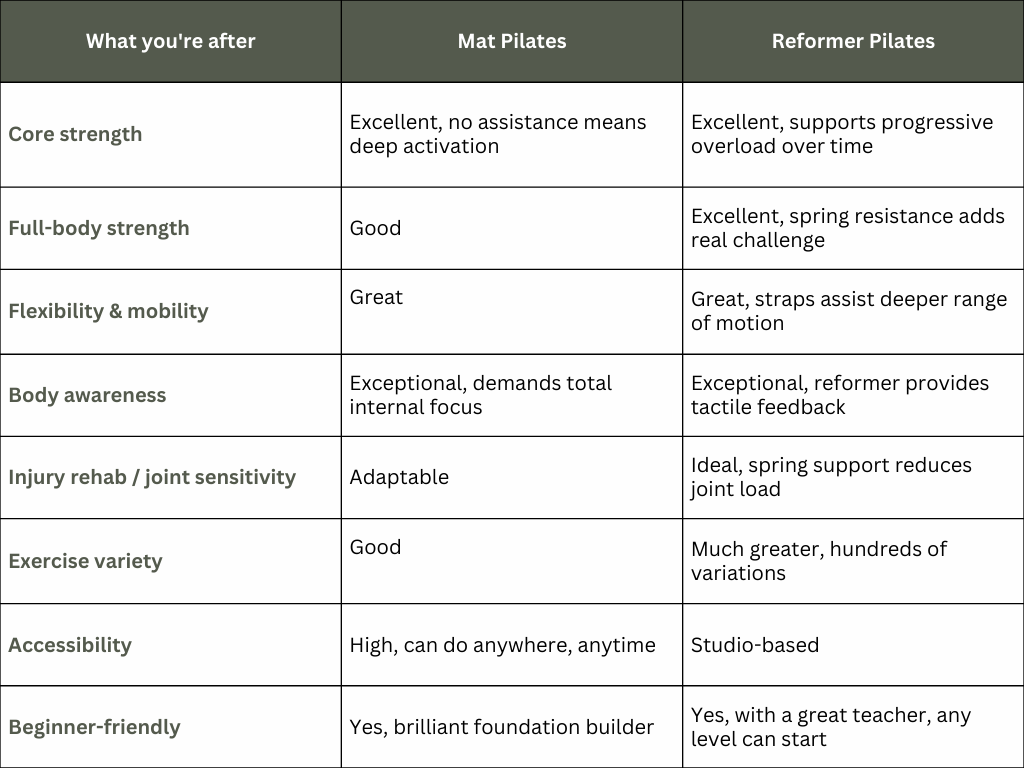
The Real Benefits, Side by Side
So… Which One Should You Choose?
Our honest answer? The best Pilates class is the one that has you coming back. But since that's not always helpful when you're trying to make a decision, here's a more specific breakdown — because we really do believe the right fit matters.
You might love Mat Pilates if…
You're brand new to Pilates and want to learn the foundational language of the method first
You're drawn to the simplicity of just you, a mat, and your breath, no equipment needed
You love having a practice that travels with you, beach, hotel room, living room, wherever
You want to build genuine core strength and body awareness from the ground up
You're easing back into movement after a break and want to reconnect with your body gently
You might love Reformer Pilates if…
You're after something dynamic and varied – a class that challenges you differently every single session
You're managing an injury, chronic pain, or navigating the pre- or postnatal period
You want to build real functional strength alongside your flexibility and mobility work
You love the tactile feedback of equipment and having structure to work within
You've been coming to mat classes and feel ready to deepen, challenge, and expand your practice
Our community's secret: A lot of our most dedicated clients do both and they'll tell you themselves that it's the combination that changed everything. Mat work builds your body awareness. Reformer work amplifies it. We often recommend a few mat sessions before your first reformer class, so you arrive already speaking the language. But it's not a rule. Come as you are – we'll meet you there.
What About Beginners, Is Reformer Really Okay to Start With?
Yes. One hundred percent. We hear this a lot in our community: "But it looks so intimidating." We completely understand — the first time you see a reformer, with its sliding carriage and springs and straps, it's a lot to take in. It looks more like something from a physio clinic than a movement practice you'd fall in love with.
But here's what we know from welcoming hundreds of first-timers through our studio doors: in a well-structured class with an experienced teacher, you will be guided through every single movement.
The reformer is genuinely designed to accommodate your body exactly as it is today. Springs can be lightened. Positions can be modified. The whole system is built to grow with you, session by session, week by week.
What matters far more than which class you start with is finding a community and a teacher who takes the time to actually know your body. That's where the results ,and honestly, the joy, come from.
-
Yes — and it's often recommended. The reformer is especially well-suited for people with back pain because the spring system can decompress the spine, support the lower back during movement, and help you build the deep core muscles that protect your back long-term. Always let your instructor know about any injuries before class.
-
2–3 sessions per week is the sweet spot for most people to start noticing real changes. That said, even one class a week done consistently will make a meaningful difference over time. Joseph Pilates himself said: "In 10 sessions you feel different, in 20 sessions you look different, in 30 sessions you have a completely new body." We've seen it happen, over and over.
-
Not necessarily — but it helps. Understanding the foundational principles (breath, centring, alignment, flow) before you add the reformer means you'll get more out of every session. Many studios offer beginner-friendly intro reformer classes that cover the basics within the session itself, so you're never left behind.
-
Reformer Pilates is often considered more adaptable than mat Pilates during pregnancy because the positions can be more easily modified for a changing body. Always seek a studio with prenatal-trained instructors and get clearance from your healthcare provider first.
The Bottom Line
Both reformer and mat Pilates are extraordinary practices. Both build strength, restore posture, develop body awareness, and with a teacher who really sees you, genuinely change the way you move through the world. The question was never really which is better. It was always: which one is right for you, right now?
And the answer to that might change. It probably will. The people in our community who've been with us for years have moved between mat and reformer, tried both, come back to one and then the other. That's not inconsistency, that's listening to your body, which is actually the whole point of this practice.
Wherever you're starting from, we'd love to be part of your Pilates story. Come in. Say hello. We'll find the right class for you together.
Your Sydney Pilates community – reformer, mat, and everything in between. We're here for everybody, every level, every stage. Find us on @thisispilatessydney